Monday 2nd February 2026
January saw an exciting new milestone on the NRT journey: the first NRT PhD completion! Dr. Sebastian Buntin successfully defended his thesis titled 'Robotic scheduling of time-critical observations' on Friday 30th January 2026 with external examiner Ulrich Kolb (Open University) and internal examiner Ricardo Schiavon. He was supervised by Chris Copperwheat and Helen Jermak. Sebastian's thesis explored a variety of methods to ensure robotic telescopes like the Liverpool Telescope can capture fleeting astronomic events such as GRBs and supernovae and utilise scheduling and weather conditions optimally to carry out the most exciting science possible. His work involved developing a framework for testing real-time cloud detection and prediction, automated extinction measurement and sky brightness and was tested on the Liverpool Telescope using the SkyCam all-sky cameras. This work was integrated into a signal-to-noise based exposure time calculation system that offers using the ability to have weather-dependent, flexible exposure times; saving unncessary minutes of integration and optimising telescope performance.
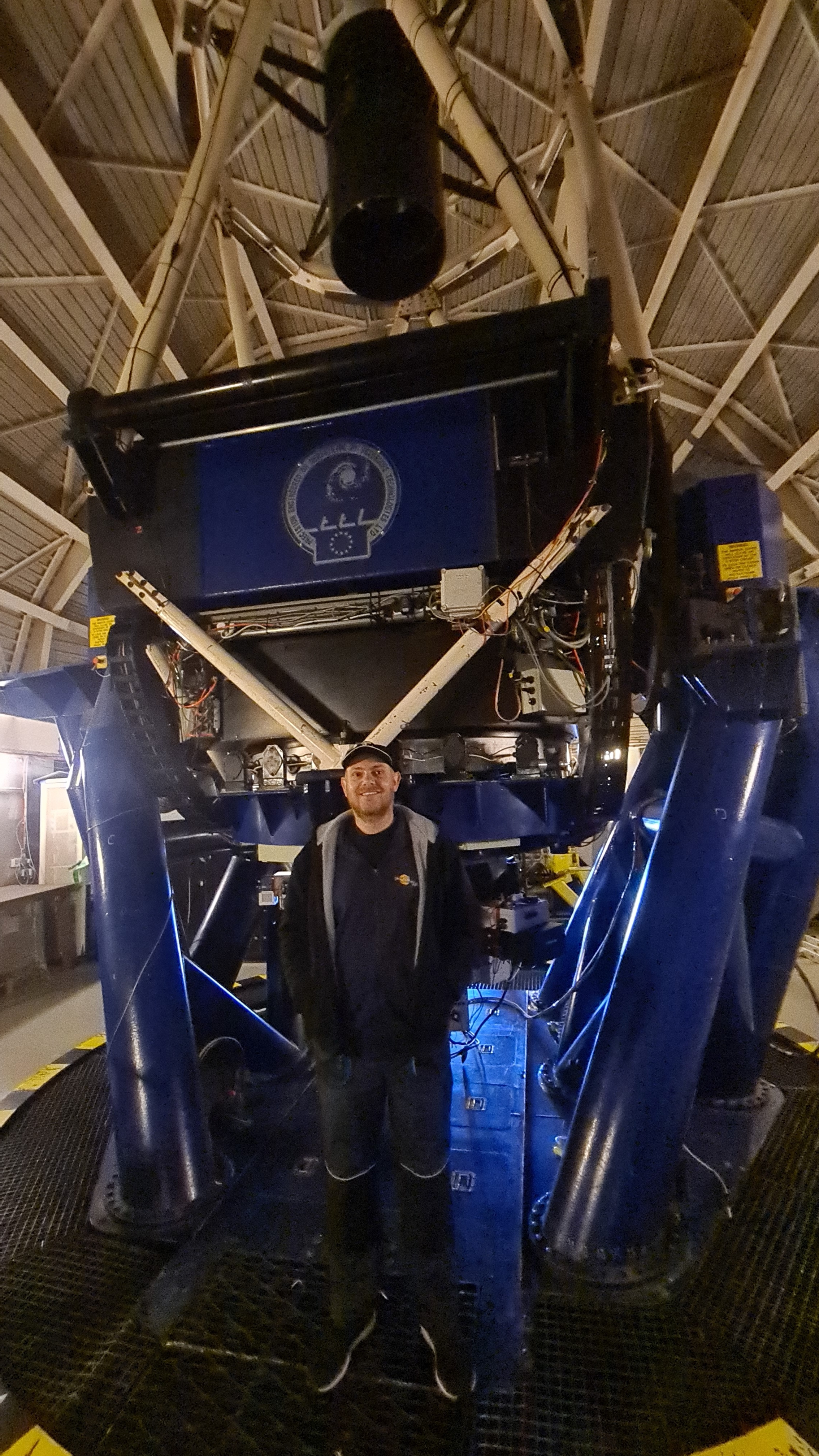
Sebastian on site at the Liverpool Telescope
Dr. Buntin said 'Completing the PhD was challenging but incredibly rewarding. I’m particularly excited that the work feeds directly into the development of the New Robotic Telescope, especially in making observing more adaptive and efficient under real atmospheric conditions.' Sebastian did his PhD via distance learning whilst based in Germany. He continues to work closely with the project to develop a software ‘bridge’ to act between the LT robotic control system and the new Phase 2 being developed by NRT staff. David Copley, NRT systems engineer, said ‘The Buntin Bridge gives us an exciting opportunity to test the new software being developed for NRT on the LT without interrupting current operations or needing time off-sky’.
The LT Scheduler Bridge is a low-risk architectural extension that will allow the Liverpool Telescope to evaluate and develop modern scheduling strategies, such as Signal to Noise-based (SNR) exposure optimisation and rapid transient response, without modifying or disrupting the existing, proven system which has been operating this way for over 25 years! The bridge will also allow the NRT team to test the telemetry and science data workflow as part of the NRT Science and Operations Data Centre (SODC) which is already in use for LT users as part of the Phase1 system.
The bridge is designed to 'listen in' to the software communication between the LT Robotic Control Software (RCS) and the Scheduler Messaging Service (SMS). This is how the Robotic Control Software finds the next target to observe: it requests the next target from the inteligent scheduller which in turn selects the best target from the entire list in the database (Phase2) and informs the RCS.
The RCS and SCS are treated as blackboxes as their software was developed a long time ago. This way risk is reduced while allowing the team to understand the interaction between the two software components and eventually re-route to a more moden scheduler (for example one designed on the NRT operating model). The bridge operates in a fully transparent pass-through mode, behaving identically to the current scheduler interface. At any time, the system can be reverted to its original state through a single configuration change.
This work advances and modernises LT infrastructure while providing the chance of implementing exciting new capabilities to LT scheduling as well as more modern operations monitoring. It also provides a opportunity to test the data handling and telemetry monitoring capabilities of the NRT SODC.
Sebastian will look to continue this work with the team by taking up a visiting researcher position at the ARI. The LT and NRT are extremely greatful of all his efforts and are excited to see this work develop the capabilities of both LT and NRT.