28th August 2025
Last month the NRT LJMU project team hosted two of the 2025 Astrophysics Research Institute Internships. This is a yearly project where LJMU internal funding allows current undergraduate students to take up a paid work placement within the ARI. Projects are pitched by the various groups within the ARI and for the last two years the NRT team have hosted students working on a vartiety of projects. The projects last for around six weeks and are designed to give the interns real world experience working on a research project to compliment their studies.
This year we have had the pleasure of hosting Daniel Villalba Hernandez and Raghad Elhomsani who were selected for the internship programme. Daniel is currently studying Mechatronics and Raghad is studying Computer Science at LJMU. The project titles were 'NRT Software test framework development' and 'Exploring the reliability of LT using data logs'. Both Daniel and Raghad joined us in early June of this year.
Raghad's project - 'NRT Software test framework development'
This project was a continuation of work from our 2024 intern Jamie Baxter. The goal was to develop automated tests which would allow the NRT software team to reduce manual test time on each software release for the Science Operations Data Centre which is currently in development as part of the LT phase 1 process. The previous project showed that by using the Laravel framework and artisan dusk components we can create tests which run when trying to merge new code to ensure other software features continue to work with the new changes.
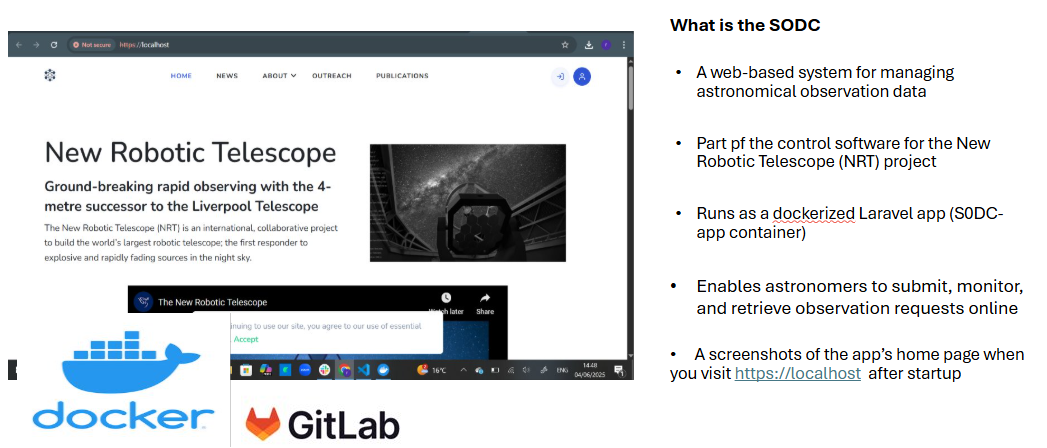
The tests basically use the website as we would expect a user to use it which helps us ensure buttons work as we expect them to, data is submitted and stored correctly and all the validation of text entry catches incorrect formatting rather than crashing the webpage.
This is a difficult task; one of the main chalenges is setting up the whole software stack locally to allow running the tests as they are being developed. Raghad had a steep learning curve when trying to setup everything locally using docker and Gitlab. A lot of this work uses industry specific tools and required Raghad to do a lot of reading to upskill on these packages before jumping into developing the tests themselves. By documenting the process as she was learning, Raghad helped us build our own understanding within the team and ensure we had better documentation for new users setting things up in future.
Another part of the project was to understand the test setup requirements in order to create and run them locally. Raghad identified that running everything locally requires a fairly high specification computer and there are many software dependancies required as part of the setup. We documented this to avoid future developers running into this issue. In the next years we hope to expand the test framework further to reduce test overhead.
An extract from Raghad's overview presentation for the project
Daniel's project - 'Exploring the reliability of LT using data logs'
This project focused on the Liverpool Telescope and was inteded to make use of the enourmous amount of log data that has built up over the 25+ years of operation. The project was supported by Guangming Zhang and Derek Braden from the Faculty of Engineering to provide their expertese in Reliability engineering.
Reliability engineering is focused on understanding why things fail and ideally predicting the likelyhood over lifetime. With so much data to pore through, the Liverpool Telescope is an excellent candidate for using large data sets to try and discover potential markers preceeding failure of a system or part.
Daniel's initial task was to automate the collection and formatting of the data. He selected a particular telescope system which we know to be prone to failure but do not fully understand the root cause of. Daniel wrote some Python scripts in Jupyter Notebooks that allowed us to answer basic questions very quickly (and importantly, rule out some assumptions). Starting with the Cassegrain rotator system, he used the failure logs to look back before the failure occurred to check certain conditions; for example temperature, pointing angle, torque readings.
The team saw the value in this new approach and will build on this prototype in the next year with the eventual aim of predicting failures before they occur. This process could involve using machine learning or artificial intelligence to spot long term patterns that are not obvious to the operations staff.
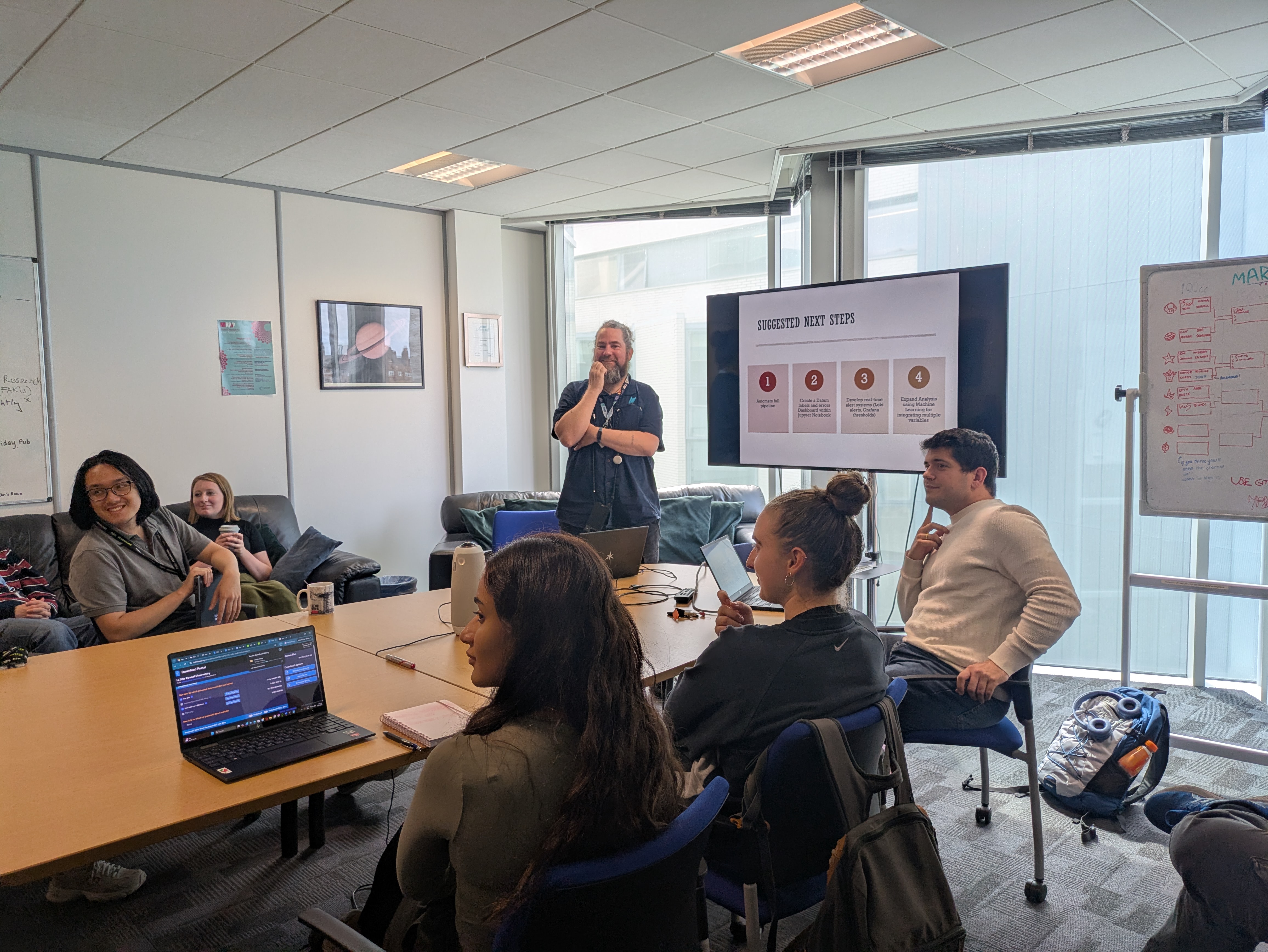
At the end of July, Daniel gave a presentation to the ARI detailing his project findings and answered questions from the attendees.
The NRT team thanks both Raghad and Daniel for all of their hardwork and wish them very well in their future studies and careers!
Daniel (right) answering questions after his presentation with the session hosted by internship organiser Gavin Lamb